
Search behavior is changing. People are no longer relying only on traditional search results to find information, compare services, and make purchasing decisions. They are increasingly using AI-powered search experiences to receive direct answers, recommendations, and summaries.
For small businesses, this creates a new opportunity: making their websites and content easier for search engines and AI-powered tools to understand, trust, and reference.
This is where Answer Engine Optimization (AEO) comes in. AEO helps businesses structure useful, accurate content so it can better serve users looking for direct answers. Whether you operate a local service business, an online store, or a professional agency, understanding AEO can help you adapt to the changing search landscape.
In this guide, we explain what answer engine optimization is, how it differs from SEO and GEO, and how small businesses can improve their visibility in AI-powered search.
What Is Answer Engine Optimization (AEO)?
Answer Engine Optimization (AEO) is the practice of creating and organizing website content so search engines and answer-focused systems can understand it and potentially use it to answer users’ questions.
Traditional SEO often focuses on improving a website’s visibility in search engine results pages. AEO places additional emphasis on providing clear, relevant, and well-supported answers to specific questions.
For example, a user might search for:
- What does SEO cost for a small business?
- How can I improve my website’s Google rankings?
- Which digital marketing services does a new business need?
- How can a company appear in AI-powered search results?
A website that answers these questions clearly, accurately, and comprehensively may be more useful to both readers and search systems.
AEO does not guarantee that Google, ChatGPT, or another AI platform will select or cite your content. Instead, it helps you build content that is easier to understand, useful to your audience, and aligned with the questions people actually ask.
Why Is Answer Engine Optimization Important in 2026?
AI-powered search experiences are changing how people discover businesses and information. Features such as Google AI Overviews and AI Mode can summarize information and provide links to relevant sources. Other AI-powered tools may also help users research products, services, and solutions.
For businesses, this means that visibility is not only about attracting clicks from traditional search results. Being a useful source of information within an AI-powered search experience may also support brand awareness and customer discovery.
AEO can help businesses:
- Answer potential customers’ questions before they contact a company.
- Build trust by publishing accurate and helpful information.
- Make important website content easier to understand.
- Address specific questions related to their services.
- Support organic search visibility through useful, people-focused content.
- Create opportunities for potential customers to discover their brand.
However, businesses should not abandon traditional SEO. Organic rankings, relevant website content, a strong technical foundation, and a good user experience remain important parts of a search strategy.
AEO vs. SEO vs. GEO: What Is the Difference?
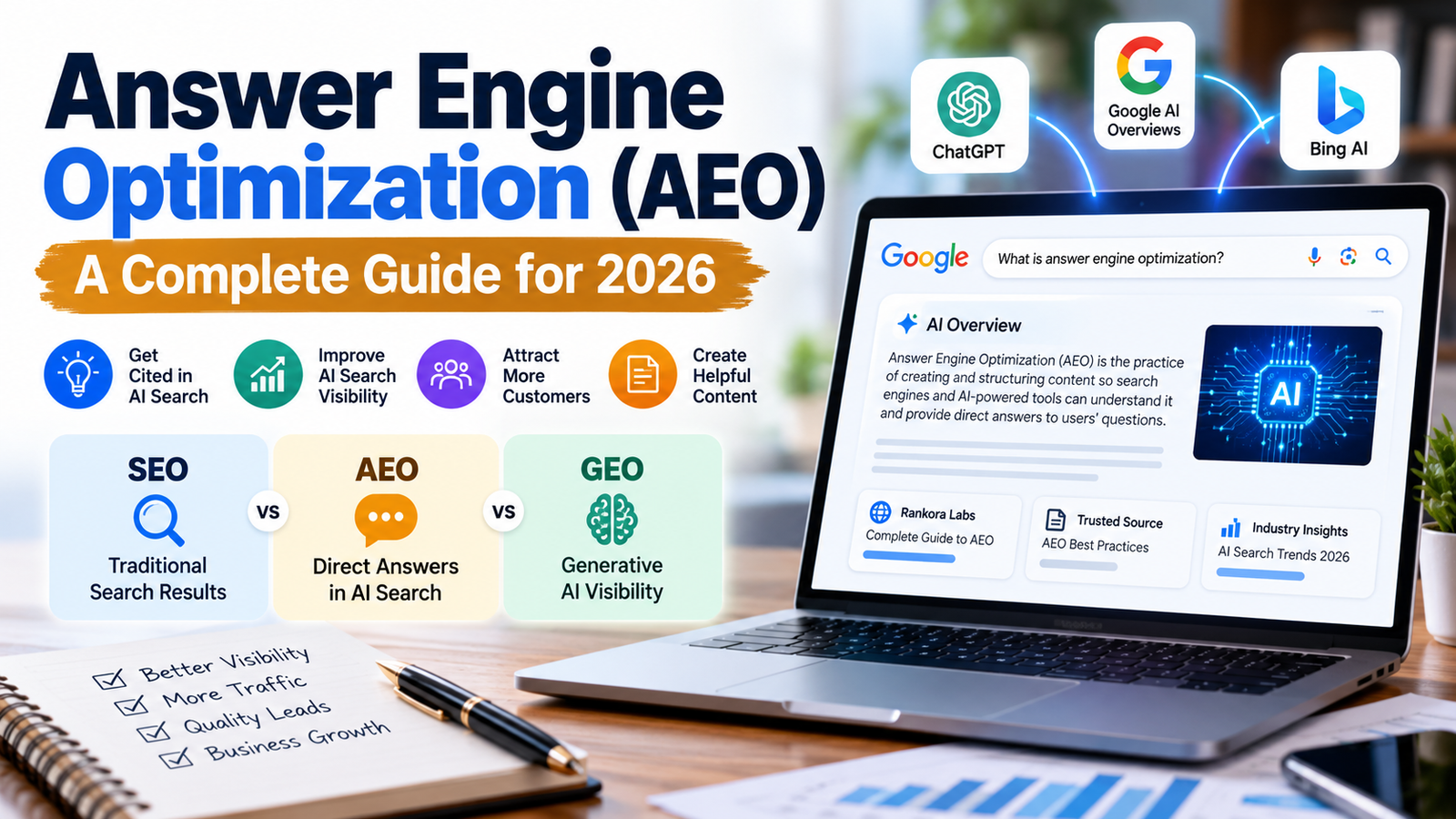
AEO, SEO, and Generative Engine Optimization (GEO) are related concepts, but they emphasize different aspects of online visibility.
Search Engine Optimization (SEO)
SEO focuses on improving a website’s visibility in organic search results. It includes keyword research, technical optimization, content quality, internal linking, site speed, and earning relevant backlinks.
For example, a digital marketing agency might optimize its service page for the keyword “SEO services for small businesses.”
Answer Engine Optimization (AEO)
AEO focuses on making content useful and understandable for question-based searches and answer-oriented experiences.
For example, the same agency might publish a detailed article answering “How much does SEO cost for a small business?”
Generative Engine Optimization (GEO)
GEO generally refers to improving the likelihood that a brand or its content will be understood, referenced, or cited in generative AI responses.
For example, a company might publish original research, clearly documented case studies, and expert explanations that help readers and AI systems understand its expertise.
These approaches overlap. You do not necessarily need three separate strategies. A strong content and SEO strategy can support traditional search visibility while making information more useful for AI-powered search experiences.
How to Optimize Your Website for Answer Engine Optimization
You do not need to rebuild your website to begin working on AEO. Start by improving the quality, structure, and usefulness of your existing content.
1. Research the Questions Your Customers Ask
Effective AEO begins with understanding your audience.
Identify the questions potential customers ask before purchasing your products or hiring your services. Review customer emails, sales conversations, support requests, search queries, and relevant industry discussions.
Keyword research tools can also help you identify question-based searches related to your business.
For example, a US digital marketing agency could target questions such as:
- What is answer engine optimization?
- How does local SEO help small businesses?
- How much do Google Ads cost?
- What is the difference between AEO and SEO?
- How can I improve my visibility in AI search?
Create content that addresses these questions directly instead of publishing articles solely to include keywords.
2. Provide Clear Answers Near the Beginning
Readers should not have to search through several paragraphs to understand the main point of your article.
Introduce the topic clearly, provide a concise answer, and then expand with examples, evidence, and practical recommendations.
For instance, an article about local SEO could begin with a short explanation of how local SEO helps businesses improve their visibility for location-related searches.
Use descriptive headings, short paragraphs, bullet points, and numbered instructions when appropriate. These formatting choices make content easier to scan and understand.
Do not reduce every topic to a short answer, though. Competitive subjects often require detailed explanations to address the reader’s needs properly.
3. Create Helpful, Original, and Trustworthy Content
Content quality is central to sustainable SEO and AEO.
Avoid publishing generic articles that repeat information already available on many websites. Add something useful through original examples, practical experience, expert commentary, research, or clearly explained processes.
For a small business website, useful content might include:
- Step-by-step guides.
- Detailed service explanations.
- Original case studies with verifiable results.
- Comparisons of relevant tools or approaches.
- Answers to common customer questions.
- Practical checklists and troubleshooting advice.
Identify the author where appropriate, explain your company’s experience accurately, and support factual claims with reliable sources.
If you use AI tools to help draft articles, review the output carefully. Correct inaccuracies, add meaningful expertise, and ensure the finished article genuinely helps readers.
4. Use Relevant Keywords Naturally
Keyword research remains useful when planning AEO content. Choose a primary keyword and a set of related terms that reflect the subject and search intent.
For an article about answer engine optimization, relevant terms might include:
- Answer engine optimization.
- What is answer engine optimization?
- AEO vs SEO.
- AI search optimization.
- Generative engine optimization.
- How to optimize for AI search.
- Google AI Overviews.
Include relevant phrases naturally in your title, introduction, headings, and body content. Avoid keyword stuffing or forcing unrelated terms into paragraphs.
The purpose is to explain the topic comprehensively, not to achieve an arbitrary keyword density.
5. Improve Your Website’s Technical SEO
Search engines need to access and understand your website’s pages. A technically sound website supports your broader search visibility strategy.
Review the following areas:
- Make sure important pages can be crawled and indexed.
- Use a logical website structure and descriptive URLs.
- Submit an accurate XML sitemap through Google Search Console.
- Check for broken links and unnecessary redirects.
- Ensure the website works well on mobile devices.
- Improve page speed and Core Web Vitals where necessary.
- Use HTTPS and maintain a secure website.
- Add relevant internal links between related articles and service pages.
Structured data, such as appropriate Organization, Article, and LocalBusiness markup, can help search engines interpret eligible information about your website. Implement only markup that accurately represents visible page content and follows the relevant guidelines.
There is no special schema type or technical shortcut that guarantees AI citations.
6. Make Your Business Information Consistent
For businesses serving a particular city or region, accurate business information is important.
Ensure your website clearly explains what your business does, which services it offers, and which locations it genuinely serves. Keep your contact details and company information consistent across relevant business profiles and directories.
If you serve customers across the United States remotely, explain that clearly. Do not claim to have a physical office in a location unless that representation is accurate.
Publish detailed service pages that explain your process, expertise, service areas, and the problems you solve. These pages can help potential customers understand whether your business is a good fit.
7. Build Relevant Internal Links and Update Existing Content
Internal links connect related pages and help readers discover more useful information.
For example, an article about AEO could link to relevant Rankora Labs pages about SEO services, content optimization, and digital marketing. The links should provide genuine value rather than simply promote services.
Review older articles regularly. Update outdated statistics, broken links, examples, and recommendations. Add missing explanations when search behavior or industry practices change.
Refreshing content should involve meaningful improvements, not simply changing the publication date.
How Can You Improve Visibility in Google AI Overviews and ChatGPT Search?
Many businesses want to know how to appear in Google AI Overviews or get cited by ChatGPT. There is no guaranteed method, and different platforms use different systems to select and present information.
Nevertheless, several practical steps can strengthen your overall online presence:
Publish useful answers. Address real customer questions with clear explanations and relevant details.
Demonstrate expertise. Include accurate company information, author details where relevant, credible sources, and verifiable examples of your work.
Maintain accessible pages. Check that important content is available to search systems and is not accidentally blocked by technical settings.
Build brand credibility. Earn genuine mentions, relevant links, customer reviews, and recognition from trustworthy sources where appropriate.
Keep information current. Review important pages and correct outdated claims.
Measure actual performance. Monitor search impressions, organic clicks, relevant referral traffic, enquiries, and conversions. Where platform reporting permits, review traffic from AI-related sources separately.
Google’s guidance for its AI search experiences emphasizes established SEO fundamentals and helpful content. You do not need to create a separate version of every article just for AI, nor does adding an llms.txt file guarantee better visibility.
Common Answer Engine Optimization Mistakes to Avoid
Businesses can waste time and resources when they treat AEO as a collection of shortcuts.
Avoid these common mistakes:
- Keyword stuffing: Repeating the same phrase excessively makes content less natural.
- Publishing low-value AI content: Large quantities of generic articles do not automatically create expertise or visibility.
- Making unsupported claims: Do not promise guaranteed AI citations or specific rankings.
- Ignoring traditional SEO: AEO should complement, not replace, a sound SEO foundation.
- Using misleading structured data: Markup must accurately reflect the page.
- Buying artificial backlinks or reviews: These practices can undermine trust and create platform-policy risks.
- Ignoring measurement: Track meaningful outcomes rather than relying only on rankings or impressions.
Focus on creating a trustworthy website that answers questions better and more completely than a generic article can.
How to Measure AEO Performance
AEO measurement is still developing, and no single metric captures every aspect of visibility across AI-powered search platforms.
Start with Google Search Console to monitor organic impressions, clicks, click-through rates, and queries that bring visitors to your website. Google Analytics can help you evaluate engaged visits, referral sources, enquiries, and conversions.
You can also periodically review whether your brand is mentioned or cited for relevant questions in supported AI search experiences. Treat these observations carefully because results can vary by query, location, user context, and time.
For small businesses, the most valuable outcome is not simply appearing in an AI answer. It is reaching the right audience, earning trust, and generating qualified enquiries or sales.
Frequently Asked Questions About Answer Engine Optimization
What is the difference between AEO and SEO?
SEO focuses on improving organic search visibility, while AEO emphasizes making content useful and understandable for question-based and answer-oriented search experiences. Both approaches benefit from helpful content, technical accessibility, and a good user experience.
Is AEO important for small businesses?
AEO can help small businesses answer customer questions, demonstrate expertise, and adapt to changing search behavior. Its value depends on the business, its audience, the quality of its content, and the results it can measure.
How long does AEO take to work?
There is no fixed timeline. Results depend on factors such as your website’s current condition, competition, content quality, indexing, and the search platform. Monitor performance over time rather than expecting immediate results.
Do I need separate content for ChatGPT and Google AI Overviews?
Usually, you should begin with useful, accurate content that serves your audience and follows established SEO practices. You can adapt content to particular platforms when there is a clear reason, but separate duplicate articles are not automatically necessary.
Can AEO guarantee that my website appears in AI search results?
No. Businesses cannot guarantee that Google, ChatGPT, or other AI-powered systems will feature or cite a particular page. AEO practices can improve content quality and discoverability, but selection is controlled by the relevant platforms.
Final Thoughts
Answer Engine Optimization is an increasingly relevant part of the evolving search landscape. Businesses can prepare by publishing helpful content, answering real customer questions, strengthening technical SEO, maintaining accurate business information, and measuring meaningful results.
The best approach is not to chase every new AI search trend. Instead, build a website that deserves to be discovered: one that explains your expertise, provides reliable information, and helps potential customers make informed decisions.
At Rankora Labs, we help businesses strengthen their digital presence through SEO, AI search optimization, content strategy, and digital marketing. If you want to improve your website’s search visibility and build a stronger foundation for long-term growth, explore our services and discover how a tailored optimization strategy can support your business goals.